Friday, July 16, 2010

Riding on the Back of a Pig into a Pool of Mud

"Defrosted: a life of Walt Disney" opens June 29 at Postmasters

A few days before the start of the New York art world's summer lull, Postmasters opened a stellar group exhibition forcing vacationers awake. A conceptually taut revisionist riff on the life of Walt Disney, the show is organized by Adam Cvijanovic and David Humphrey, and features 14 additional artists. Summer in the city beckons most galleries to throw group shows, but this one, planned for 2 years, has thrown down the gauntlet.


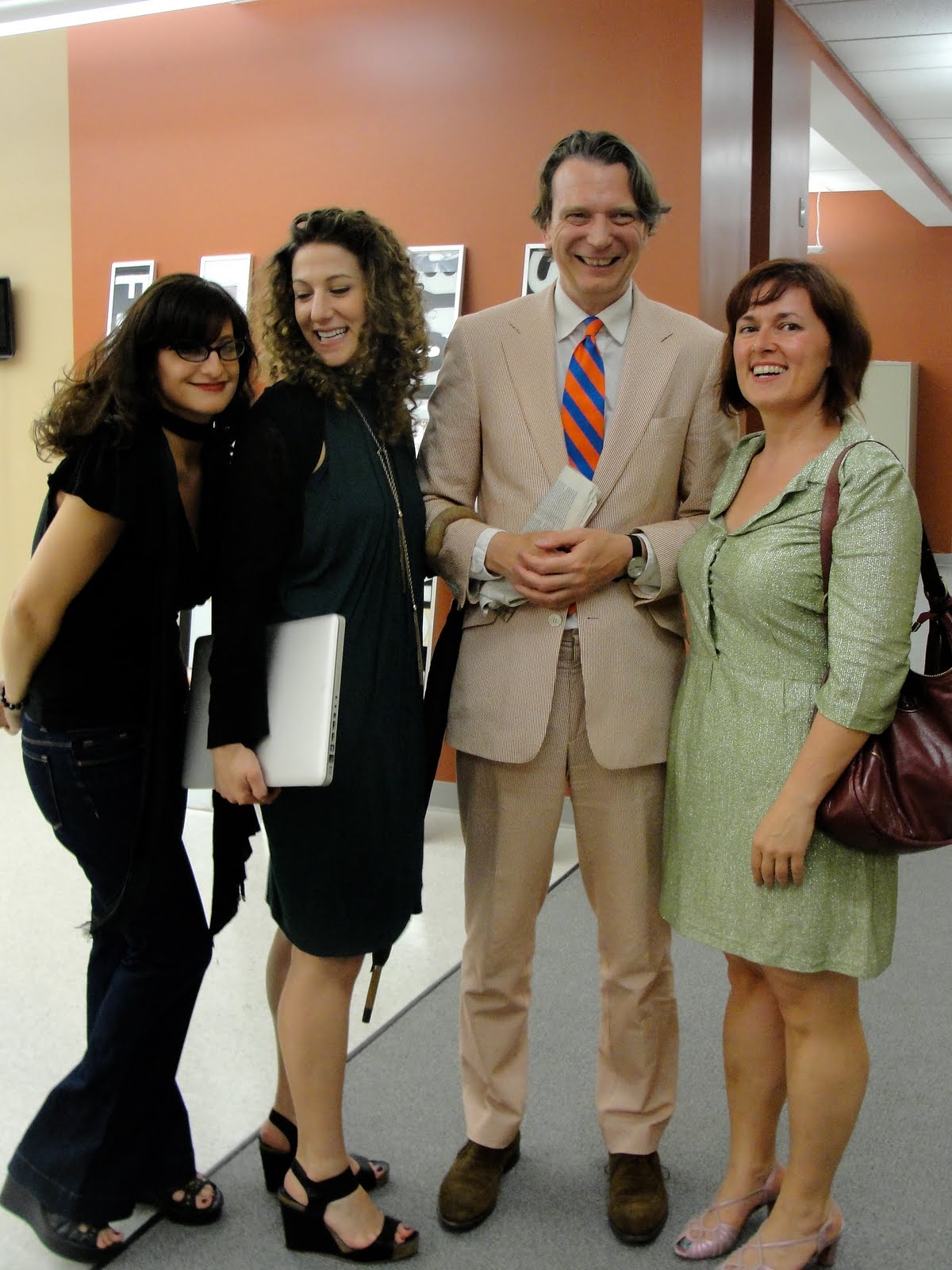
Right: David Humphrey and featured artist Inka Essenhigh.

The entire main gallery is covered with a wall painting by Cvijanovic, with figurative parts painted by Humphrey, and additional canvases by Humphrey playfully hung throughout. By the entrance of the gallery, a timeline of Disney's life creates a comical leitmotif that throws the otherwise fantastical show into sharp relief, the kind of truth that our current reality-TV modernity finds prickly and illusive at best. Related works by artists both known and Ebay-anonymous hang on a scaffold recreating Magic Mountain, itself based on the Matterhorn.

Left: artist Nika Sarabi.


Right: detail of Nika Sarabi's work.

The crowded opening emphasized the room-filling expanse lushly imagined by Cvijanovic. An artist who makes painting seem as easy as brushing one's teeth, Cvijanovic continues to push his style into a modern reinvention of history painting. Humphrey's cartoony tendencies are also a perfect fit for this thematic exhibition. In cohesive yet distinctive styles, both artists re-imagine a workshop ideal, even asking Nika Sarabi, an artist familiar with graffiti, to add detail to an abandonned spaceship from Disneyworld's Tomorrowland.

Left: "Addio", Eva and Franco Mattes, aka 0100101110101101.org, hung on pedestal.

In the back room, several works were supposed to represent Walt Disney's crypt, and indeed it was a quiet somber room, with a video and giant Mickey sculpture. A truly ambitious undertaking, the entire exhibition concerned itself not just with the reinvention of biography and the collaborative process, but also the physical challenge of having imagery taking over the room. The exhibit placed the viewer in a warped Einsteinian time/space dimension, which particularly was pronounced during the packed opening. And yet as viewers looked up at the walls, they were brought back into the objecthood and subjectivity of each individual artist placing their work on the pedestal cum Matterhorn. A heady and yet perfectly summer-themed exhibit indeed--catch it before it closes on August 6!


Left: Paula Wilson, "After All", mixed media on wood, on pedestal.

Tuesday, July 6, 2010

Freedom Sparks in Montreal

"Freedom's Discontents: Resistance, Subversion, and Survival"

A triumverate of curators--Irys Schenker, myself and gallery director Bettina Forget put together a video exhibition at Montreal's Visual Voice Gallery. The show is up only through July 17, but viewable online at Visual Voice Gallery. My selections and essay (reprinted below) are viewable at LightCube Video.


The response to the Freedom Sparks open call for videos has been overwhelming, and has garnered submissions from all over the world. This is indeed the beauty behind a show such as this: curators from New York have looked at videos from Brussels, Japan, and Arizona, among others, and the works will be viewed in a gallery in Montreal. This process has informed the interpretation of the concept of freedom, and provided a range of reactions - personal, national, or abstracted, and with these examples we can glimpse the expanse of our world.

Biying Zhang abstracts black and white footage of the Pan Asian Games in China with abrasive editing and sound, into a reflection on the calamity and destruction behind the facade of governmental control. In a place where freedom has a nuanced history, a propaganda machine aims to portray a happy and modernized China, which the artist counteracts with his pointed video.

Elise Rasmussen similarly delves into local history: the disappearance of native culture in Newfoundland. Her poignant, meditative approach, combined with bilateral framing, gives a nuanced viscerally-felt evocation of place. In a free society, without overt warfare or pursuit of genocide, an ethnic group nonetheless slowly is eradicated. What can freedom mean when a groups survival itself is so tenuous?

Tobias Rosenberger investigates another disappearance: of landscape and its inhabitants, an erasure brought about by the results of commercial freedom. A development, the height of material choice, brings about a sudden death, and Rosenberger shows us the end result of deadening conformity.

Daniel Stitts provides a personal and hauntingly beautiful nugget of personal and sexual freedom. Motifs of hiding, disappearance, and even the use of recorded voice all create layers of obstruction to personal liberty. Simone Patterson's fun brightly-colored piece subverts her underlying themes of feminity submerged in domesticity, vanity, and modern womens forced juggling of roles. And finally, Robby Rackleff's humorous lecture, toying with the ease of home-made video fakery, posits freedom as something that each generation fears and resents.

Thursday, July 1, 2010

Cuchifritos: bootie-licious

Left: The entrance of Cuchifritos Gallery, Installation view: "Collected:Working Space 10". Courtesy of the artists and Cuchifritos Gallery/project space. Photo: Scott Taylor.

On yet another sweltering NYC day, while gallery-hopping through the Lower East Side, I decided to stop by Essex Market, a wonderful locavore outpost that reinvents a neighborhood paradigm from the turn of the century into a thriving food-based marketplace. Luckily for me, I wandered into the cozy corner space of Cuchifritos Gallery, just as the opening for its new exhibit "Collected:Working Space 10" began.

Right: Crocheted floor, by Olek.

Curated by Erin Riley-Lopez, the exhibit features work of the artists in the Lower East Side Rotating Studio Program, housed nearby. The show managed within a confoundingly small space to be a testament to the high caliber of the artists, as well as the range of conceptual work within. Although the works were in video, painting, sculpture and performance, the idea of mark-making outside the boundaries of conventional drawing was profoundly felt.

For instance, Chris Yormick used Connect Four checkers to create a blunt facial pattern, and Natsu's red filament-and-bead web took over a corner of the space. Echoing its organic/cosmic patterning was Olek's camouflage-meets-sportswear carpet, which covered the entire floor. The one actual drawing used marks to extend beyond the paper: Blane de St.Criox's "Gitmo: abandonned camp x-ray" pushed past political authority by using barbed wire's thwarted beauty as mark to suggest freedom's grand schemes unravelled.

Left: pile of used booties.

The artist Olek sat by the entrance offering slippers to all entrants, pantomiming as her mouth was embroidered shut. Her crocheted carpet effectively thrust mark-making into the three-dimensional realm, and labeled each guest as participant. The gallery was taken over by the mark, and within its womb-like space, a sea of pink and purple, each foot trod carefully on the art, each leg yet another mark, extending upward.

Right: Olek, at right, silently waiting to proffer slippers.

Saturday, May 22, 2010

"Painting with Pictures": loco con sabor!

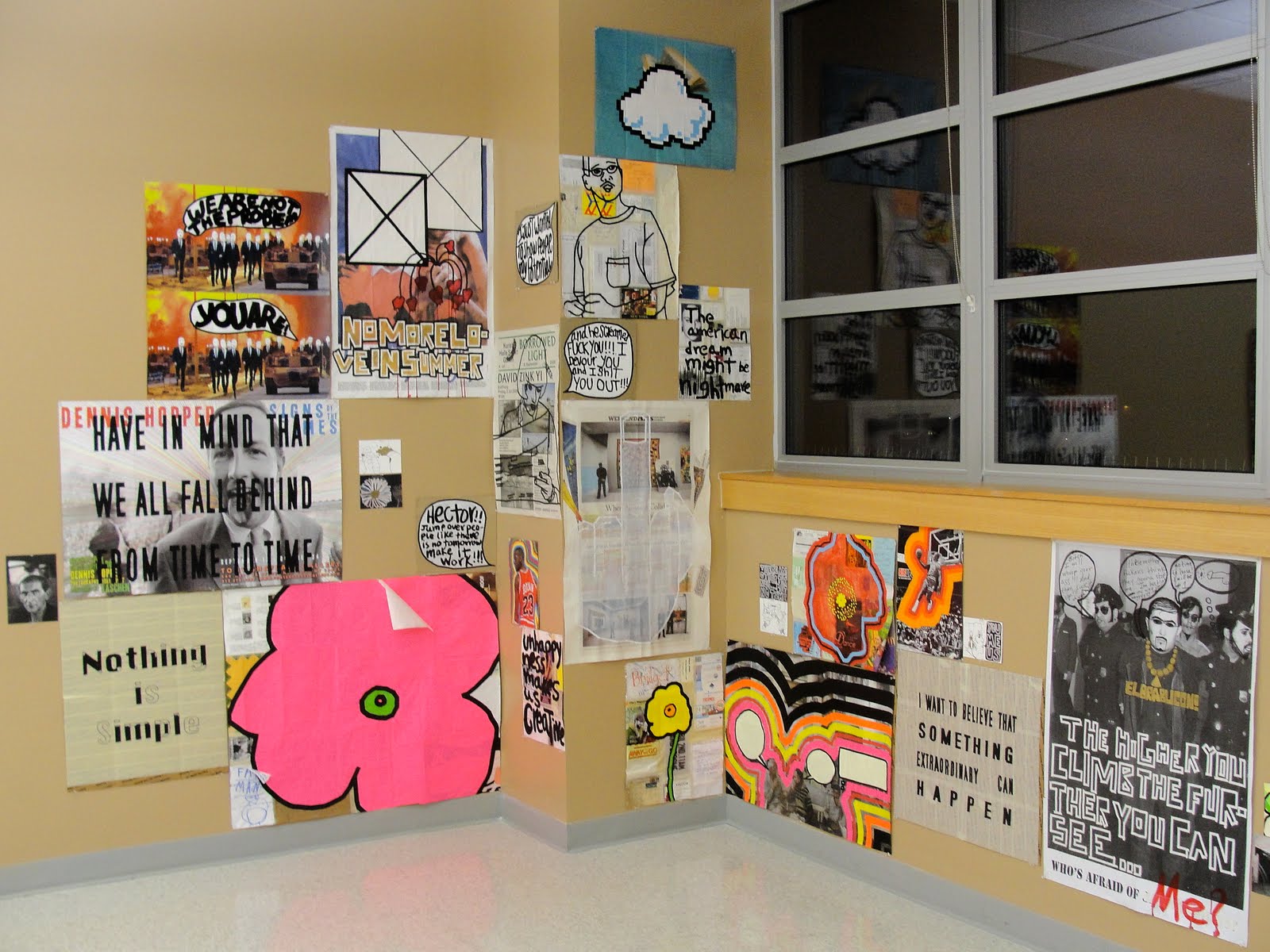
I am very excited to announce the show I co-curated with David Gibson and Savannah Spirit, "Painting with Pictures", opened last night at the Casita Maria Center in the Bronx. The show of 32 artists revisits the concept of collage, and will have a follow-up "Part II" in the winter. Casita Maria is a gorgeous building, a few minutes walk from the 2, 5, and 6 trains, and the show is on the top floor, affording lovely views of city rooftops, sunsets, and the elegant stream of ever-present traffic on the Bruckner Expressway.


Right: Hector Madera-Gonzalez installation of collage on found posters.

Left: Artists Tim Rollins and Conrad Vogel.

After a lovely opening, the madding crowd assembled at a Mexican restaurant across the street, and supped on deliciosos Camarones a la Mexicana, freshly-chopped guacamole, and endless glasses of "apple juice" (code for beer). I could barely hear anyone as the jukebox regaled us with forlorn ditties in Spanish, and as I stumbled into the wrong door to have a breath of fresh air, I was pleased to be mortified by a posse of 6 decked-out gals, who clearly felt I had stumbled not only into the wrong door but perhaps the wrong neighborhood. I look forward to revisiting the show in the light of day, as the art changes in the daylight, and the neighborhood beckons with fruit vendors, vibrant graffiti, and a street culture that encourages interaction. Casita Maria has been a fixture in the neighborhood for over 74 years, but the building is only 2 years old and looks it, with gleaming floors, brightly colored walls, and kids energized by their exposure to art and culture.

Right: Director of Development for Casita Maria David Dean adjacent to a matching collage by Amelie Chunleau.

The exhibition continues through July 21, and features works by: Michael Anderson, Melissa Barrett, Chris Bors, Lesly Canossi, Amelie Chunleau, Nancy Drew, Chris Fennell, Carla Gannis, Liam Hanna-Lloyd, Halsey Hathaway, Daniel Kayne Scott, Kiernan, Isolde Kille, Elissa Levy, D. Dominick Lombardi, Hector Madera-Gonzalez, Leah Oates, Sarah Olson, Deborah Pohl, Alexander Reyna, Elizabeth Riley, Ron Rocheleau, Pamela Saturday, Raven Schlossberg, Kaeko Shabana, Jennifer Shepard, Mary Ann Strandell, thefactory101, Austin Thomas, Conrad Vogel, and Michael Zansky.

This exhibition explores the use of collage as an artistic medium, dissecting its impulses and agendas while providing a wide cross-spectrum of its usage in contemporary art. It addresses the role of material culture in mediating our shared view of reality, the notion of a borrowed aesthetic, and how specific visual agendas express differing cultural attitudes. It includes a variety of mediums and aesthetic agendas, presenting not only traditional collage, but works which establish a collage mentality in the liminal forms of photography, video, digital manipulation, painting, sculpture, printmaking, children’s books, commercial signage, portraiture, and others. In the end, it will posit collage as a cause, rather than a symptom, of both artistic style and generational meaning.

Casita Maria Center for Arts and Education; Casita Gallery, 6th Floor
928 Simpson St (Bet Fox/Baretto St & 163rd St)

For more information, check out their website: Casita Maria Center.

Right: Savannah Spirit, Lyla Rose, David Dean, and Asya Geisberg.

The Last Days of Chez Deitch, Part II

Line of people waiting to get into Deitch Projects, at opening night, Shephard Fairey, May 1, 2010.

Like his gallery openings with their crowds of people in the streets, Jeffrey Deitch himself is equal parts NYC and LA ,and always has been, sans silicone and fake tans. At Shephard Fairey's opening on May Day, Mr. Deitch wore a characteristically pastel pink suit, and (as seen on YouTube) caught swearing with a venom not unlike that of Ari Gold in "Entourage", Mr. Deitch will fit right into LA.

Left: barricaded at the entry, nervous people fret.

Shephard Fairey's opening, on a warm Saturday evening, was a scene straight out of "Exit at the Gift Shop". Crowds lined up hours before the start of the official opening, and the line was an event in itself, stretching around the block, 10 hipsters thick , and slow to move. Opposite the line was an unfettered block party, with fancy motorcycles whose shapes, colors and collaged naked ladies vied for attention with the staid flat graphic art within the gallery.

Posing and preening among the motos were a group of bedazzled, bejewelled, be-tatted, and sometimes bearded gents, presumably the owners of the bikes, though they could have been a bunch of models from the anti-Hell's-Angels department.

Celebrities abounded, including Tyson Beckford (left), quick to arrive and to depart. It all seemed strangely of another era--80's fabulous-- but sadly without the substance inside. I like the idea of Shephard Fairey much more than the reality: someone whose hard-working street art style has blossomed into a full-fledged commercial career, thanks to a certain Obama poster, and of course buoyed by Deitch's happy collaboration. Fairey was likable in "Exit through the Gift Shop", which I highly recommend as a parable about art-world hype. In that movie, an unlikely protagonist [thrift-shop owner-turned artiste] becomes a semi-celebrity due to a massive marketing campaign, yet his work rips off every other street artist and pop artist, including Fairey himself.


Fairey also recycles many a Pop and propaganda idiom, and happily admits to it, but inside a gallery his work suffers. So-called street art serves a purpose and attains a power that circumvent the Deitches of this world. The international nature of the art itself is even more fascinating, and its demographic is far wider than that of most "fine" artists. Mr.Deitch has had a long history of working with graffiti-based artists, and among these, Fairey's work is the tamest. And as for Mr.Fairey, who would turn down an opportunity at having Tyson Beckford, motorcycles, and fancy dogs at his opening, not to mention lines of eager beavers trying to get in?

Left: installation view of Shephard Fairey, "May Day" exhibition.

Sunday, May 2, 2010

The Last Days of Chez Deitch, Part 1

Left: Rosson Crow at Deitch Projects, 3/4/2010.

Jeffrey Deitch's departure from our fair city for LA has been much-chronicled, and although I've charted a 50/50 hit rate with his artists (still much higher than most galleries), the element I'll miss most is the medieval-pageantry aura of his openings. While I only caught Jules de Balincourt on a quiet Tuesday, I found the openings of Rosson Crow, held during the first day of Armory Week, and of Shephard Fairey, held last week on the heels of a currently-playing movie featuring Fairey [Exit at the Gift Shop], to be extravaganzas of glamor.

Right: Graffiti-top, brick wall pants, man about town.


Left: Keith Haring tunnel with contemporary urban texting dweller.

But to be accurate, the glamor was of a certain very democratically-accessible sort: celebrities, collectoristas [one part fusty collector one part fashionista], and young kids with neon colors and ripped t-shirts all co-mingled and pretended to ignore each other. With all the hubbub of a movie premiere but without the velvet ropes (although the long lines at the Fairey show necessitated a special VIP-only line complete with bouncers), each opening reminded one of a Fellini-esque fete--yes, not quite circus-like, but certainly I'll miss my little pinch of Deitch's Dolce Vita.

Left: photographer waiting to snap as Rosson Crow greets fans.

Right: Rosson Crow's ball gown, all poufs and trains.

Rosson Crow's paintings were in themselves a tribute to art-worlds past: titled "The Bowery Boys", each painting was an homage to Bruce Nauman, Keith Haring, and other 80s stars, as well as subway trains, and now-gone places such as CBGBs. The meta-celebration of "Better Days Gone By" was everywhere--but in the person of a confident young artist who seduces with vibrant splashes of paint (detail at right) and loud bangs of ambition, one felt a kinship, and a re-imagining, rather than a sad eulogy or empty envy of the glitz and grit of the 80s art scene. Deitch's desire to cycle through (some say devour and spit out) younger artists was at least for this one evening an example of a benevolent dictator throwing a bread and circus for his subjects; and what a wonderful circus it was. Among the crowd were the equally young prodigy designer Zac Posen, Rosson Crow and several other ladies wearing the bright warm hues found in many of her paintings, onlookers in baseball caps or high heels, all in a gleaming white space that one has to ascend into, as if into a privileged inner cloister.

Left: matching lady-in-waiting.

Thursday, March 11, 2010

The Armory Fair: "Hang In There, Baby"

"Hang in there, Baby." (Left) Fans of Sean Landers’s onanistic career of would be proud of his latest endeavors—a booth full of work at Friedrich Petzel Gallery, and a perfect 2010 art market recap. Landers expressed not just what he, and by extension all self-involved artists (that is to say, all artists) are thinking, but what the entire art world is self-reflexively musing. "Ne me quitte pas", the kitten pleads: don't leave me, dear collectors!


Right: Jack Shainman's booth on Saturday.

But fear not, this year’s Armory Show was brimming with art, although crammed with smaller and medium–sized works rather than the giant warhorses of years past. The show was overrun by all manner of species: on opening day, the VIPs, VVIPs, and countless press and looky-lous roamed the stalls in their Wednesday best. By Saturday, at Pier 94 (the more contemporary of the two), security tried to manage the queue for the stairs to prevent trampling, clueless parents brought their strollers and carriages, and there was not even a spare bit of floor to rest a weary derriere.
One artist complained of spilling her $16 glass of Champagne due to the madding crowds, and many were heard to mutter not-to-silent screams of "MOVE!!".

Left: Artist Nick Cave, at Jack Shainman, with El Anatsui wall hanging behind him.

Right: Detail, Nick Cave sculptures.

Jack Shainman had a mobbed booth, but the art, all colorful vim and vigor, more than held its own. Nick Cave's soundsuits, a perennial art fair favorite, were pared down to a single element or color, becoming ever more mysterious, undermined by the smiling face of the artist himself.

Left: Rina Banerjee at Nathalie Obadia.

Galerie Nathalie Obadia had a museum-worthy dramatically lit staging of Rina Banerjee's works. By Saturday her sculptures' delicate protrusions had forced the gallery to tape the entire booth off, as the gallerists sat a table nearby, pleine d'ennui. Banerjee's cultural mishmash of references was submerged in the impact of the objects themselves, confusing yet evocative, and happy to display a reliance on old-fashioned visual "wow".

Right: Nicole Klagsbrun Gallery, carpet.

Left: Nicole Klagsbrun's booth, with yellow swastika on right.

Nicole Klagsbrun's booth was a show-stopper as well, its all-over neon yellow-green so bright that gawkers didn't notice the swastika painting on the wall. The entire installation was by artist Adam McEwen, but the connection between all the works and the arresting color wasn't nearly as clear as the shrewdness of having a wide-open booth at an intersection that stopped viewers in their tracks.


Left and Right: Tony Feher at Pace.

The opposite effect occurred at Pace, where viewers plunged into an all-black room of Tony Feher table-top installations. His mundane object and recycled aesthetic worked best up close. Plastic water bottles, caps, bunched up aluminum foil, an old globe with a bow out of string, were not as gingerly arranged as Sarah Sze works, or explosively strewn as a Jason Rhoades installation, but rather the work of a bricoleur of midling ambition, which I mean as a compliment.

Left and Right: Isa Genzken at Hauser & Wirth.

The Armory was full of glitter, embroidery, festive color, and celebration, even if it came in photos of slums in Third World countries (i.e. Zwelethu Mthethwa at Shainman). Isa Genzken's "Disco 'Soon' (Ground Zero)" had a perplexing title, but its beads , ribbons, and red paint perhaps suggested that we can smooth over our tragedies by getting back to partying mode.

Right: Houseago head looking at another head.

Figuration also was prominent, mostly in painting and sculpture. With a huge work at the Whitney Biennial, Thomas Houseago showed several large primitivist bronze busts at The Modern Institute.


Tony Matelli's life-size epoxy girl in underwear titled "Sleepwalker"( left) found her way into a tightly packed Leo Koenig booth. Her hyper-realist body surrounded by clothed oglers made me think of her as exploited, suggesting everyone's Freudian nightmare of being caught in public naked.

On the other hand, some work seemed able to survive only within the art fair context: Jonathon Monk's instruction "Do Not Pay More Than $40,000" in neon had an effect that lasted exactly 2 seconds, by the third, one had moved on mentally and visually.

Right: Jonathon Monk at Lisson gallery.

As jaded and begging for entertainment as one is at the Armory, it was still possible to solicit a reaction. The first thing I heard upon entering the Fair was a German couple clearly scandalized by some naughty photos in Horton & Co.'s booth.
"Mein Got, mein Got", they gasped to each other--imagine how much it takes to shock our usually-less-sanctimonious European connoisseurs.

Among the VIPs were the usual celebs and art-celebs, though it was so crowded I only glimpsed one: a very jaded Tracey Emin glaring in boredom at her smartphone, but proud of finally being recognized she gamely posed for me (Left). Fashion-wise, fur coats and fur hats were positively wooly mammoth-like even though the climate was more like Bombay. One woman had a half coat, clearly too fashion-proud to take it off (hello, free coatcheck!)--(Right). Zebras were also in favor, in all black-and-white shoe, dress, and coat (i.e. Left).

And speaking of species, an explosion of ladybugs was unleashed mid-Saturday, to the disbelief and confusion of security guards-- "I guess we can vacuum??". Within an hour they were extinguished by lesser means: death by stiletto-squish. I thought it was a cruel gag, as if we needed more side-show distractions, especially at such a cute creature's expense. At least those were the only casualties, as the health of the art fair was pronounced "stable".